Based on the rate you enter, not an official inflation forecast or financial advice.
Inflation Calculator – Project Future Value with Compounding
This inflation calculator shows how much money you would need in the future to match the purchasing power of a given amount today. It uses a **compounding annual inflation rate** that you choose — meaning the rate is applied year after year to an already‑inflated amount. This tool is useful for: - long‑term financial planning - estimating future costs - understanding purchasing power erosion - comparing today’s prices with future equivalents - illustrating how compounding inflation works It does **not** pull official inflation data; you choose the rate you want to model.Inflation Formula
To project an amount forward using a compounding rate, use: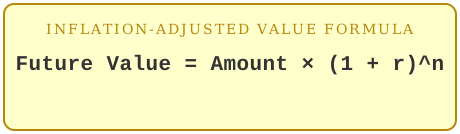
Where: - **amount** = today’s value - **rate** = annual inflation rate (as a percentage) - **n** = number of years The formula applies the inflation rate each year, compounding the effect over time.
Examples of Inflation Over Time
Example 1: 3% inflation over 10 years$1,000 today, at an assumed 3% annual inflation rate:
1000 × (1 + 3/100)^10 = 1000 × 1.3439 = 1343.90
You would need $1,343.90 in 10 years to match the purchasing power of $1,000 today.
Example 2: 2.5% inflation over 5 years
$500 at an assumed 2.5% annual rate:
500 × (1 + 2.5/100)^5 = 500 × 1.1314 = 565.70
You’d need $565.70 in 5 years to match today’s purchasing power of $500.
Example 3: 6% inflation over 20 years
$10,000 at an assumed 6% annual rate:
10000 × (1 + 6/100)^20 = 10000 × 3.2071 = 32071
Over 20 years at 6%, the equivalent amount more than triples — showing how powerful compounding becomes over long periods.
When to Use This Calculator
Use this calculator when you want to see the effect of a **chosen compounding rate** over time. It is ideal for: - estimating future living costs - projecting long‑term expenses - comparing future and present values - understanding inflation’s cumulative impact For a **single one‑time percentage change** (not compounded over years), use the percentage change calculator instead.Frequently Asked Questions
Where does the inflation rate come from?You choose it. This calculator does not pull live or historical inflation data — enter whatever rate you want to model.
Can I use this for investment growth?
Yes. The math is identical to compound interest calculations; only the interpretation changes.
Why does a small rate make such a big difference over many years?
Because the rate compounds — it’s applied to an already‑grown amount each year. See why compounding isn't simple addition for more on this effect.
Related tools: compounding over time & salary increase calculator.