This is a mathematical calculation only, not investment advice.
CAGR Calculator – Compound Annual Growth Rate Explained
CAGR (Compound Annual Growth Rate) is the single yearly growth rate that would take a value from its starting point to its ending point over a given number of years, **assuming the growth happened at a constant rate every year**. It is a smoothed, averaged growth rate — real year‑to‑year changes may fluctuate dramatically, but CAGR compresses all those ups and downs into one clean number. CAGR is widely used in: - investing and portfolio performance - business revenue growth - savings and interest calculations - long‑term financial projections - comparing growth across different time periods It provides a clearer picture than simple averages, because CAGR accounts for compounding.CAGR Formula
To calculate CAGR, use: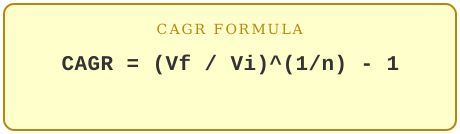
Where: - **Vi** = starting value - **Vf** = ending value - **n** = number of years The formula raises the growth factor (Vf / Vi) to the power of 1/n, which extracts the equivalent annual growth rate.
Examples of CAGR
Example 1: Investment growthAn investment grows from $10,000 to $16,105 over 5 years. What is the CAGR?
CAGR = (16105 / 10000)^(1/5) − 1 = (1.6105)^0.2 − 1 = 1.10 − 1 = 0.10
The CAGR is 10% per year.
Example 2: Business revenue growth
A small business’s annual revenue grows from $200,000 to $291,700 over 4 years.
CAGR = (291700 / 200000)^(1/4) − 1 = (1.4585)^0.25 − 1 = 1.10 − 1 = 0.10
The CAGR is 10% per year.
Example 3: Savings account growth
A savings account grows from $5,000 to $5,304.50 over 2 years.
CAGR = (5304.50 / 5000)^(1/2) − 1 = (1.0609)^0.5 − 1 = 1.03 − 1 = 0.03
The CAGR is 3% per year.
When to Use This Calculator
Use CAGR when you want a **single smoothed growth rate** over multiple years. It is ideal when: - yearly growth rates fluctuate - you want to compare long‑term performance - you need a normalized growth rate - you want to remove volatility from the calculation If you only need the percentage change between two values without a time dimension, use the percentage change calculator instead.Frequently Asked Questions
Is CAGR the same as the average annual growth rate?No. A simple average of yearly percentage changes can be misleading because it ignores compounding. See why you can't average growth rates directly.
Can CAGR be negative?
Yes. If the ending value is lower than the starting value, CAGR will be negative, representing a compounded decline.
Does CAGR account for volatility?
No. CAGR only considers the start and end values. To measure fluctuations along the way, use the volatility calculator.
Related tools: why you can't average growth rates directly & percentage change calculator.