Percentage Difference Calculator – Compare Two Numbers Fairly
Percentage difference measures how far apart two numbers are, without assuming that either one is the starting value. Both numbers are treated equally, making this method ideal when there is no “before” or “after.” It is commonly used for comparing prices, measurements, survey results, scientific readings, or any situation where you simply want to know how different two values are. Percentage difference is not the same as percentage change (which is directional) and not the same as percent error (which compares a measured value to a known or accepted true value). Use percentage difference when both numbers are equally valid; use percent error when one number is the “true” or expected value.Percentage Difference Formula
The formula for percentage difference is: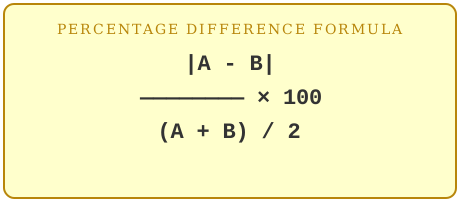
This formula uses: - the **absolute difference** between the two numbers - divided by their **average** - multiplied by 100 to convert to a percentage Because the average is used, the result does not depend on which number is entered first.
Examples of Percentage Difference
Example 1: Price comparisonTwo stores sell the same blender: Store A for $80, Store B for $100. What is the percentage difference?
|80 − 100| / ((80 + 100)/2) × 100 = 20 / 90 × 100 = 22.22
The percentage difference is 22.22%.
Example 2: Measurement comparison
Two students measure their plant’s height: 150 cm and 165 cm. What is the percentage difference?
|150 − 165| / ((150 + 165)/2) × 100 = 15 / 157.5 × 100 = 9.52
The percentage difference is 9.52%.
Example 3: Survey results
Two surveys report approval ratings of 45% and 52%. What is the percentage difference?
|45 − 52| / ((45 + 52)/2) × 100 = 7 / 48.5 × 100 = 14.43
The percentage difference is 14.43%. Since these inputs are already percentages, the 7‑point gap can also be expressed in percentage points.
When to Use This Calculator
Use percentage difference when neither number is the “before” and neither is the “after.” Typical examples include: - two prices from two stores - two measurements - two survey results - two scientific readings If one number clearly represents the starting point and the other the result over time, use the percentage change calculator instead. It will give a different (directional) answer.Frequently Asked Questions
Does the order of the two numbers matter?No. Percentage difference is symmetric — entering A and B gives the same result as entering B and A.
Can I use negative numbers?
The formula is best suited to positive values. With mixed signs or values that sum to zero, the result becomes undefined or misleading.
Is this the same as percentage change?
No. Percentage change treats one number as the starting point; percentage difference treats both numbers equally.
Percent difference vs percent error — what's the difference?
Percent difference compares two equally valid numbers. Percent error compares a measured value to a known or accepted true value. Use percent difference for comparisons like prices, measurements, or survey results. Use percent error for scientific accuracy checks, lab measurements, or experiments where one value is the “correct” one.
Related tools: percentage change calculator & percentage points vs percentage change.